Friday, 23 September 2011

Diet in Chronic Renal Failure (CRF) - Under Haemodialysis

Your diet will be very important in helping you to feel better and achieve successful treatment. The following dietary nutrients are especially important to regulate in the person receiving dialysis treatment; protein, sodium (salt), potassium, calories and fluids. A dietitian can tell you specifically which foods you should avoid and which foods would benefit you, according to their sodium, potassium and protein content. In general, there are less dietary restrictions after kidney transplant.
It is important that you follow these guidelines that have been suggested specially for you.

(A) Fluid intake
It is extremely important that you strictly adhere to the fluid intake allowance prescribed by your doctor. If you take more fluids than allowed, water will accumulate in your body, leading to serious complications such as a pulmonary edema and hypertension. Generally your fluid intake should be such that the weight gain is restricted to 1.5-2 kg between two haemodialysis sessions.

(B) Sodium (salt) intake
Your doctor will prescribed you a specific amount of salt to be taken per day. Please make sure that you consume the prescribed amount of salt (and not more) every day. Too much of salt intake will result in hypertension, increased thirst etc. Too little salt also will lead to problems such as weakness, and hypotension during dialysis; therefore it is important to take the prescribed amount of salt every day.
Salt substitutes (Lona salt) contain high potassium, hence avoid such preparations.

(C) Potassium intake
Reduce potassium intake
Increase in the potassium level of your blood will have very serious consequences and therefore, it is important that your potassium intake is restricted to the minimum possible. Following food items are rich in potassium and all of them should be avoided or taken in very restricted quantities.
(1) Fruits
Please obtain specific instructions from your dietitian regarding the restriction of these in your diet. The dietitian will help you to choose a low potassium diet which will best suit your particular requirements. Only one fruit (100 gms) can be taken per day (pineapple, apple, papaya or guava).
(2) Vegetables
All vegetables contain potassium. Wash, peel and cut vegetables into small pieces, soak in warm water for 2-3hrs, discard water and add large volume of fresh water, cook and discard water.
(3) Others
Tamarind, spices, condiments and coconut are to be used in very small quantities. They contain very high amount of potassium.
(4) Avoid
Avoid nuts, jaggery, instant coffee, chocolate, cocoa powder and salt substitutes (Lona salt)

(D) Protein intake
In the pre dialysis phase of Chronic Renal Failure(CRF) all the patients are advised to restrict protein intake. Once the patient is on regular dialysis he/she should take high protein diet (fish, chicken without fat, egg white for non-vegetarians and soya protein for vegetarians)

(E) Calorie intake
It is important that your calorie intake is adequate while you are on maintenance dialysis. Inadequate calorie intake will result in loss of weight, generalized weakness, reduced resistance to infections etc. Therefore, please check with your doctor regarding your daily calorie allowance and adhere to the recommendations given by the doctor.

(F) Dietary intake during the dialysis procedure
You are allowed to take anything you like, during the dialysis, but it must be consumed within the first hour of you dialysis. Even food items rich in potassium may be taken during this time. If you wish to take such items, please make sure that you inform the dialysis technician or nurse who is taking care of your dialysis. When you inform them, they will be able to ensure adequate removal of the excess potassium consumed during the first hour of dialysis.

Sunday, 18 September 2011

CROSS INFECTION

The following are the methods of transmission of cross infection :
Direct contact : The organisms can be transmitted directly from person to person through kissing, sexual contact, droplet infection and infected hands.
Indirect contact : Contact with the secretions and excretions of the infected persons.
Through fomites : Eg., instruments, utensils etc.
Through contaminated food and water.
Through insects.
Through dust.
Through carriers.

PREVENTION OF CROSS INFECTION IN THE HOSPITALS
  1. The hospital should be well ventilated.
  2. Maintain the general cleanliness of the hospital. Sweeping and mopping of the floor should be done daily with antiseptic lotions and damp dusting should be done to keep the articles free from dust. All the articles are kept clean and dry. Once in a week, roof is swept to remove the cobwebs. Beds, lockers, stools etc should wash and cleaned. The mattress, pillows and other unwashable articles are exposed to sunlight and aired. Periodical white washing of the walls, painting of the doors and windows etc., should be done.
  3. Safe food and water supply : Many diseases are transmitted through food and water. Kitchen and pantry are protected from flies. There must be provision for safe water supply.
  4. Safe disposal of excreta : Urine, stool, sputum etc., should be disposed safely. The bedpans, urinals, sputum cups etc., are cleaned and disinfected before it is used for the next patient.
  5. Safe disposal of refuse : Discarded dressings, garbage etc., are collected daily and burnt to prevent the spread of infections.
  6. Destruction of rodents and insects : Rodents and insects play a great role in the spreading of diseases, so, they should be destroyed.
PREVENTION OF DIRECT CONTACT WITH INFECTED PERSON (BARRIER NURSING)
Barrier nursing or isolation technique is intended to confined the micro-organisms within a given and recognized area. There are a number of isolation techniques and precautions used to prevent the spread of infections.

Respiratory isolation : Respiratory isolation is indicated in the situations where the pathogens are spread on droplets from the respiratory tract. In this type of isolation, masks are generally worn by the nurses. Gowns are also worn when caring for the small infants because of the possibility of drooling by the infants. When possible the patients are taught to cover their noses and mouths with several layers tissue paper or handkerchief. If tissue paper is used they should be disposed properly. Handkerchiefs are cleaned and disinfected before it is used again. Restrict the number of visitors. Precautions must be taken when collecting sputum specimens from the patients. When attending to a patient with respiratory infection, the nurses should keep a reasonable distance to prevent the droplet infection and to prevent breathing contaminated air. If the nurse suffering from respiratory diseases should not attend to the patients.

Enteric isolation : Enteric isolation is indicated when the pathogens are transmitted in faeces. For this type of isolation it is not necessary to wear a mask, but it is recommended that gloves and gowns be worn when handling soiled articles.
Thorough hand-washing should be emphasized both by the patients and the nurses. The excreta may be disinfected by adding lime to it before the disposal. The soiled articles such as linen should be disinfected before it is sent for washing.

Wound and Skin isolation : This type of isolation is for pathogens which are found in wounds and can be transmitted by the contact with the wounds or by contact with the articles contaminated with the wound discharges. Usually gowns and gloves are worn in this type of isolation. Important point to remember is the safe disposal of dressings and discharges from the wounds and the disinfection of the articles. Strict isolation techniques should be followed when caring for the patients with abscesses, boils, infected burns, gas-gangrene, anthrax, rabies, tetanus, venereal diseases, scabies etc. All the articles used for these patients should be kept separate.
Great care should be taken by the nurses to prevent cuts or abrasions on their hands. Frequent and thorough hand washing reduces the chances of infection.

Blood isolation : This type of isolation is intended to prevent transmission of pathogens that are found in blood. Therefore any equipment that comes in contact with the patient's blood should be carefully disinfected before touching another object or person. Use of mosquito nets are also emphasized to prevent this type of infection.

Friday, 16 September 2011

What about Carbs?

A lot of people believed that one of the main drawbacks of common Indian diet is the excess consumption of carbohydrate. In India, rice or wheat are using for preparing most of the dishes. Along with that vegetables, legumes, meat, poultry, fish or eggs are used in smaller portions as side dishes. The main role of these side dishes are to add spice and taste to the main dish. But now the concepts have being changing.
Now experts saying that foods which are rich in carbohydrate are essential for a good nutrition in diabetes.

HOW IS IT EFFECT?
The carbohydrate present in the foods is the only nutrient that make a higher impact on the blood glucose level. Insulin plays the main role in controlling our blood glucose level. The balance between carbohydrate that we taken and insulin produced by our body or taken as medication impacts blood glucose level and diabetes control.

What type of foods contain carbohydrate?
All the foods that we have taken won't give us the adequate nutrients, which are essential for our body. The amount of nutrients varies in different foods. The three essential nutrients that we need are carbohydrate, fat and protein. Most of the calories in foods shown, are from carbohydrate. Some of these foods contain good or healthful carbs, and other containing less-healthful carbs.

A food containing Good/Healthful carbohydrate
Carbohydrate containing foods which are rich in vitamins, minerals and fiber, helps us to avoid empty calories from added sugars. These are comes under the line of healthful carbohydrate foods. Similar servings of related foods may surprise you nutrition wise. For example, 1/2 cup of orange juice with pulp (fiber) and enhanced with calcium offers more nutrition than 1/2 cup of orange drink, which gets most of its calories from corn syrup. Taking fiber is a healthy way to lose weight and at the same time to keep maintaining a good digestion. Having a healthful carbohydrate instead of less-healthful carbohydrate is considered as smart eating.

Carbohydrate rich foods
Samples of foods with Healthful Carbohydrate (little or no added sugar)
  • Bran cereal.
  • Beans.
  • Popcorn.
  • Berries.
  • Pear.
  • Whole grain pasta.


How much carbohydrate do you need to get your essential vitamins, minerals and fiber?
Most of the experts suggest that you get 45-65 percent of your calories from carbohydrate sources. If you eat less carbohydrate, especially if you take lesser than 1,500 calories daily, won't gives you the needed nutrients. Eat unrefined, nutrient-rich foods containing carbohydrate - whole grain, unprocessed and fiber-filled foods rather than refined starches and sugar-added foods and drinks, which contains few nutrients and lots of calories. "Even while eating out, you have to be smart and work around what you get. Increase your intake of vegetables, for instance".

Thursday, 15 September 2011

LIFE IS SWEET

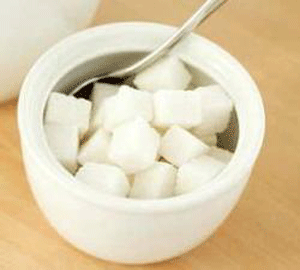
You can have your cake and eat it too. Now a days sweeteners offer great options for reducing carbohydrate, lowering calories and yielding such delicious results that you simply do not miss real sugar. You will be spoilt for choice with this list..


Some of the popular Sugar substitutes / Sweeteners and their brand names :

Sugar substitutes
  • Sucralose  - Splenda, Zero, Sugar Free Natura approved by FDA.
  • Aspartame - Equal, Sweetex, Sugar Free, Sugar Free Gold.
  • Stevia - Stevi0cal, Gwiser, Dr Shugar, So Sweet.
  • Acesul - Sweet One.
  • Saccharin - Sweet 'N' Low, Sweet Twin, Necta Sweet, Sweetex.
  • Other sugar alcohols - Sorbitol, Xylitol, Mannitol, Malitol etc.


ADVANTAGES OF USING SUGAR SUBSTITUTES:

There are many advantages of using artificial / reduced calorie sweeteners. some of them are :
  • Weight loss. Overweight / Obese individuals often choose to have artificial sweeteners in their foods so that they can reduce the total calorie intake in their diet, which in turn leads to weight loss by creating a negative energy balance. By doing so, they do not have to totally avoid or sacrifice the foods they love to eat.
  • Diabetes Mellitus. With the increasing prevalence of diabetes in the world, especially type 2 diabetes, people have started using artificial sweeteners to limit their total calorie intake as well as maintain their sugar levels by avoiding simple sugars, and enjoying most of the foods they like.
  • Dental problems. Sugar substitutes are not fermented by the micro flora of the dental plaque, and therefore they are tooth friendly.


Q. Is it advisable for people without any serious health-weight problems to be using sugar substitutes? Should it be used in moderation? Why?
A. Artificial sweeteners should still not play an important role in a healthy and balanced diet. In spite of the green signal given to most of the sweeteners, they are no substitute for good nutrition. They do not contain calories.